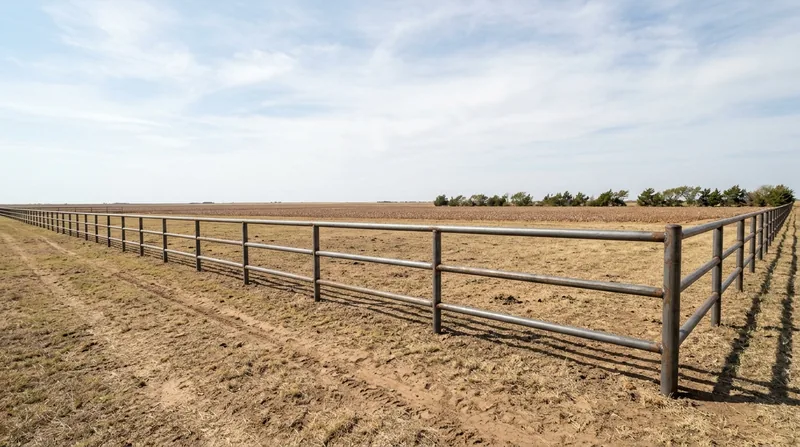




Farm fence installation in Lubbock means working with the flat, wind-exposed terrain of the South Plains and the real fencing needs of rural acreage across Hockley, Lynn and Crosby counties. Whether you're securing pasture for horses, containing livestock, or marking property lines across open cotton country, the fence has to stand up to spring gusts that push long runs over, hard caliche soil that shifts posts, and the intense high-altitude sun that grays and cracks wood in a single season. We install ranch rail, no-climb horse fence, field wire and pipe fencing on straight lines over long flat runs, with braced corners and gates sized for trailers and equipment. Our crews set posts in concrete, brace corners against the wind, and size everything for the work it has to do. Read on to understand what farm and ranch fencing costs, how the installation works, and what to expect from a contractor working on your acreage near Lubbock.
Why Farm and Ranch Fencing Matters on the South Plains
Acreage in and around Lubbock sits on flat, treeless horizon country where the wind is constant and the soil is caliche and sandy clay loam. A fence that works in other climates fails here because the wind loads are real, the ground shifts, and the sun moves the wood fast. Ranch rail and no-climb horse fence have to be built with braced corners, concrete-set posts on proper spacing, and hardware that does not sag. Field wire and pipe fencing require tension and anti-sag bracing so the runs stay true over 100-foot stretches. A gate that swings freely in town can bind or drop on acreage because of settling, wind load and the way the ground moves.
- Braced corners and anti-sag bracing hold long runs straight in spring wind and summer heat.
- Concrete-set posts on proper spacing stop frost heave and caliche shift from moving posts up and down each winter.
- Gates sized for trailers and equipment need self-closing self-latching hardware and cantilever or V-track systems that work on uneven ground.
- No-climb horse fence and field wire require tension bands and stretcher bars installed correctly so the mesh stays tight and animals cannot climb or push through.
A fence built right keeps livestock in, marks boundaries clearly, and holds up to the weather and the work for years.
Key info: Acreage around Idalou, Slaton and Ransom Canyon faces the same wind and soil challenges as central Lubbock. Posts that are not concrete-set in caliche will work loose within two to three years, and corner bracing is not optional on long runs.
If you have an existing fence that needs repair instead of replacement, we evaluate it first. Many ranch rail and pipe fences can be straightened, re-tensioned or braced rather than torn down. See our fence repair service for details on what can be saved.
How Farm and Ranch Fencing Installation Works in Lubbock
We start with a walk of your property to identify the fence line, check for underground utilities, and assess the ground and wind exposure. Every job begins with a call to 811 for a utility locate, because digging post holes without that locate is illegal in Texas and dangerous. Once utilities are marked, we lay out post positions, set them in concrete on proper spacing, and build from there. For ranch rail, that means setting 4-by-4 posts, hanging rails, and bracing corners. For no-climb horse fence and field wire, we set posts, run the wire or mesh, tension it with stretcher bars, and install tension bands to keep it tight. For pipe fencing, we set posts, run the pipe, and brace against wind load.
- Call 811 for a utility locate before we dig any post holes, as required by Texas law.
- Walk the property and mark the fence line, checking for easements, deed restrictions and HOA rules that govern height and material.
- Lay out post positions on proper spacing (typically 6 to 8 feet for ranch rail, 4 to 6 feet for wire and field fencing) and dig holes to frost depth.
- Set posts in concrete and brace corners with diagonal members to hold against wind load and settling.
- Hang rails, run and tension wire or mesh, install hardware, and test gates for smooth operation.
The whole process is built around making sure the fence stays straight and tight through the seasons.
Example: A 200-foot run of no-climb horse fence on acreage near Wolfforth took three days: one day to locate utilities and dig holes, one day to set posts in concrete and let it cure, and one day to run and tension the mesh, install stretcher bars, and hang the gate. The customer could turn horses out the next morning.
For more detail on gate installation and sizing, check our gate service page.
| Fencing Type | Description | Best for |
|---|---|---|
| Ranch Rail | 4-by-4 posts set in concrete with 2-by-6 or 2-by-8 rails, typically 3 or 4 rails high, braced corners. | Pasture, horse property, visible boundaries, aesthetic appeal. |
| No-Climb Horse Fence | Wire mesh or polymer-coated mesh stretched tight between posts, tensioned with stretcher bars and tension bands, self-closing gates. | Horse pastures, containment where climbing or escape is a risk, long runs on open acreage. |
| Field Wire and Split Rail | Wire fencing (barbed or smooth) or split rail hung on posts, braced corners, anti-sag bracing on long runs. | Livestock containment, property marking, rural acreage, cost-effective long-run fencing. |
| Pipe Fencing | Steel pipe hung on posts, welded or bolted, braced against wind load, durable in harsh conditions. | High-wind areas, equipment containment, industrial or heavy-use acreage, long-term durability. |
Farm and Ranch Fencing Cost in Lubbock: What to Expect
Ranch rail and no-climb horse fence start at around $12 to $18 per linear foot, depending on the height, the material (treated wood versus composite rail, or wire gauge and mesh type), and the ground conditions. Field wire and split rail fencing run $8 to $14 per linear foot. Pipe fencing costs more, typically $15 to $25 per linear foot, because of material and welding. What moves the price up or down is the length of the run, post spacing, corner bracing, the number and size of gates, and the difficulty of the ground (caliche, rocky soil or water table issues add cost because digging takes longer and post setting may need special equipment).
A 500-foot run of ranch rail with two gates on acreage near Shallowater runs roughly $6,000 to $9,000. A 400-foot run of no-climb horse fence with one gate runs $3,200 to $7,200. These are ballpark figures and assume standard post spacing, concrete-set posts, and normal ground conditions. Hard caliche, deep frost depth, or terrain that slopes or has obstacles will raise the cost because the work takes longer.
The best way to know what your job will cost is to get pricing guidance from our full pricing page and then call us at (806) 702-7964 for a free estimate. We walk your property, measure the run, identify the ground conditions and any obstacles, and give you a firm number. Most estimates come back within 24 hours, and there is no obligation to book.
What to Look for When Hiring a Farm and Ranch Fencing Contractor Near Me in Lubbock
Farm and ranch fencing is skilled work, and the contractor you choose will determine whether your fence stands straight and tight for years or starts sagging and failing within a season or two. Start by checking that the contractor carries general liability and workers' compensation insurance and can provide a certificate of insurance on request. In most of the South Plains, residential fencing under a certain contract value does not require a licensed general contractor, but you should confirm this with your local building department because the rules change across jurisdictions. Ask the contractor directly how permits work in your area and whether your job needs one. Many HOAs and deed-restricted communities in Lubbock require approval before any fence work begins, so check your property documents and HOA rules before you call.
- Get at least two or three estimates from contractors who have done ranch rail and no-climb fence work on acreage in your area.
- Ask each contractor to walk your property, measure the run, and explain how they will set posts, brace corners and install gates.
- Request references from recent ranch fencing jobs and call them to ask about the quality of the work and how the fence has held up.
- Confirm that the contractor will call 811 before digging and will obtain any required permits from your county or city.
- Check your HOA documents or deed restrictions to see whether your fence design, height or material needs approval before work starts.
A contractor who takes time to explain the work, answers your questions clearly, and carries insurance is worth the call. Contact us for a free estimate and see how we approach the job.
Farm & Ranch Fencing in Lubbock: Pricing Guide
| Service | Price | Details |
|---|---|---|
| Ranch Rail Fencing | Starting at $12/ft | 4-by-4 posts in concrete, 2-by-6 or 2-by-8 rails, braced corners, standard post spacing on normal ground |
| No-Climb Horse Fence | Starting at $12/ft | Wire or polymer mesh, tensioned stretcher bars, tension bands, self-closing gates, long-run capability |
| Field Wire and Split Rail | Starting at $8/ft | Wire fencing or split rail, posts in concrete, anti-sag bracing, cost-effective livestock and property containment |
| Pipe Fencing | Starting at $15/ft | Steel pipe, welded or bolted, braced for wind load, durable industrial or high-use acreage applications |
| Complex acreage or difficult ground | On estimate | Hard caliche, rocky soil, water table issues, slopes or obstacles add cost because digging and post setting take longer |
| Estimate and travel | Free | Property walk, measurement, ground assessment, and travel included in Lubbock and surrounding South Plains counties |
Indicative pricing, the exact cost depends on square footage, finish, and site access. Free personalized estimate within 24h at (806) 702-7964.


